


Samsung is about to break its own rules for clamshell foldables with a highly calculated hardware risk. By abandoning its single-chipset strategy, the upcoming Galaxy Z Flip 8 Chipset strategy creates two entirely different performance tiers based on where you live. This decision to divide on the basis of the 2nm Exynos 2600 and 3nm Snapdragon 8 Elite Gen 5 is a massive bet. It attempts to balance next-generation semiconductor innovation with brutal supply chain economics.
The 2nm Pioneer Versus The Global Standard
The decision to fragment processors introduces immediate performance comparisons and highlights two distinct architectural philosophies. Qualcomm’s Snapdragon 8 Elite Gen 5 remains the established benchmark for raw, reliable power. Built on a 3nm process around 3rd-generation Oryon CPU cores, it pushes AnTuTu benchmark scores into the 3.9 to 4.5 million range. This Galaxy Z Flip 8 Chipset offers a solid 20% CPU performance boost over its predecessor.
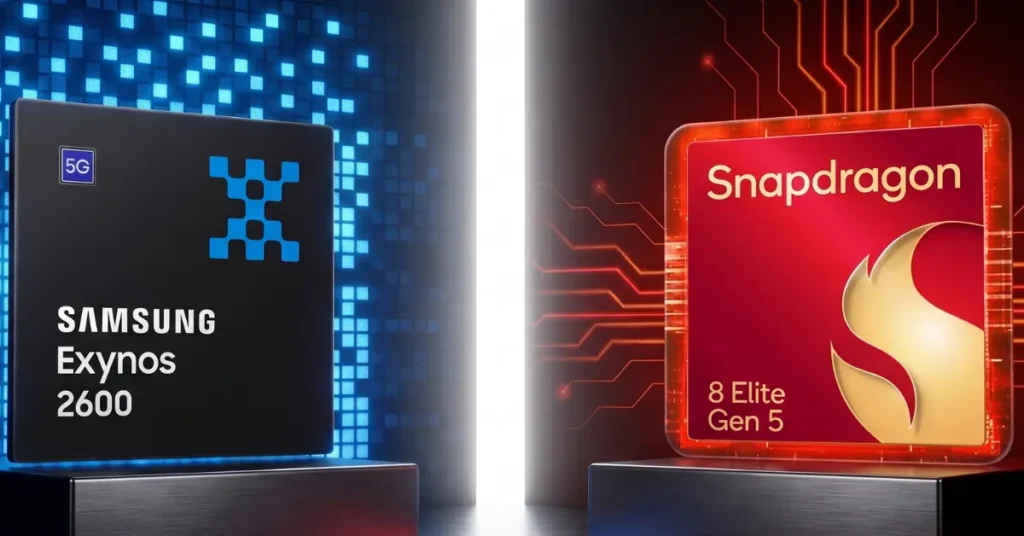
On the other side of the Galaxy Z Flip 8 dual Processor equation sits the Exynos 2600. This marks Samsung Foundry’s massive debut of the 2-nanometer Gate-All-Around, or GAA, process. Early synthetic benchmarks may hover slightly below the Snapdragon counterpart. However, its architecture focuses intensely on computational density, aiming to maximize efficiency and multitasking capabilities within a smaller footprint.

Graphical Power And The Mobile Gaming Divide
Sustained graphical performance is entirely non-negotiable for mobile gamers, and the dual-chipset approach means users will experience two completely different graphics engines. The Snapdragon variant features a highly optimized Qualcomm Adreno GPU. This engine delivers a 23% overall graphics improvement and a crucial 25% boost in ray tracing. It is heavily tuned by developers for sustained frame rates in intensive mobile titles.
The Exynos 2600 utilizes an AMD-partnered Xclipse GPU to handle intense visual rendering. The critical test here will be its ability to match Qualcomm’s highly tuned drivers. Preventing dropped frames during extended gaming sessions will determine if this Exynos variant can compete in real-world scenarios. We are watching the ultimate Exynos 2600 vs Snapdragon 8 Elite Gen 5 showdown play out in real time.
Battling Heat In A Confined Clamshell
The Galaxy Z Flip 8’s clamshell design severely limits physical space for traditional vapor chamber cooling. This makes thermal management the most critical hardware hurdle for Samsung to clear. To manage the heat generated by the ultra-dense 2nm node, the Exynos 2600 pioneers a brand new Heat Path Block, or HPB, cooling technology. This hardware is specifically engineered to pull heat away from the processor core.
The Snapdragon variant counters this thermal challenge through sheer operational efficiency. Qualcomm brings a 35% improvement in CPU power efficiency and an impressive 16% overall SoC power savings. The chipset that successfully avoids thermal throttling under heavy loads will ultimately dictate the superior day-to-day foldable experience.
On-Device NPU Parity And The AI Gap
On-device AI acts as a core pillar of modern global tech ecosystems. Neural Processing Unit speeds dictate how fast everyday features like live translation and generative editing actually function. The Exynos 2600 boasts a massive 113% generative AI performance improvement over the previous generation. This makes it a highly capable on-device AI SoC designed to power complex local tasks.
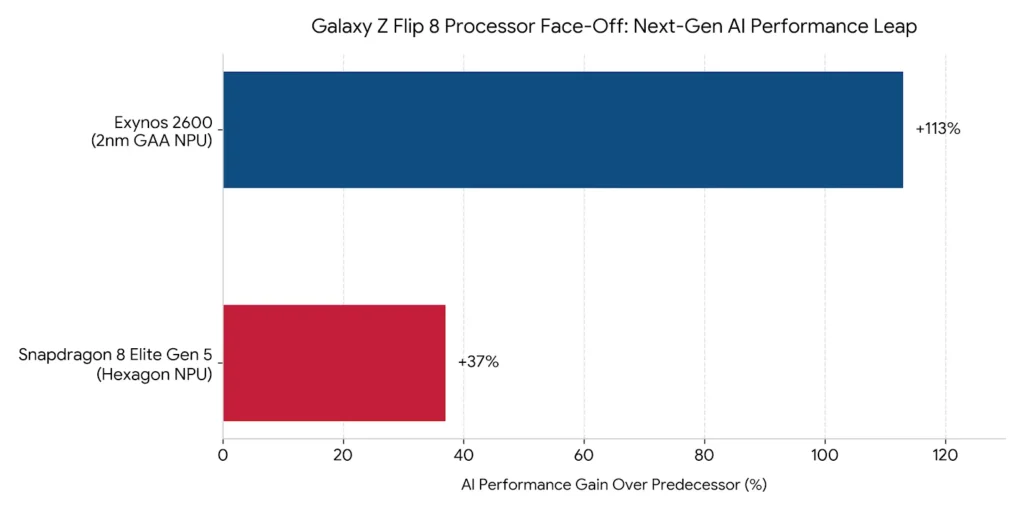
Qualcomm’s Snapdragon advantage comes from its upgraded Hexagon NPU. This unit claims to be 37% faster than its predecessor and natively supports Advanced Professional Video, known as APV. Any discrepancy in AI response latency between the two chips risks alienating users who expect absolute parity in premium software features across all regions. Recent Galaxy Z Flip 8 leaks suggest buyers are already comparing these metrics closely.
Supply Chain Economics Dictate Global Distribution
Beyond raw performance, this Galaxy Z Flip 8 dual chipset strategy is fundamentally driven by production costs and profit margins. The bleeding-edge 2nm Exynos 2600 costs approximately $270 per unit to manufacture due to lower early-node yields. Conversely, the more established Snapdragon 8 Elite Gen 5 costs $230 per unit to secure. By balancing these expensive 2nm chips with more affordable Snapdragon units, Samsung actively protects its global profit margins.
The unanswered question is whether this $40 component differential would result in somewhat cheaper retail price in Exynos areas, or if Samsung will simply absorb the savings. We can see the regional distribution plan taking shape through current Samsung Galaxy Z Flip 8 specs floating around the supply chain. The US, Canada, China, and Japan will receive the Snapdragon models. This leverages existing carrier trust and deep consumer preference for Qualcomm’s proven modems.
Europe, South Korea, and the rest of the world will serve as the actual proving ground for the new 2nm Exynos 2600. If the chip delivers robust performance and solid battery life, it will massively strengthen Samsung Foundry’s reputation as a top global semiconductor leader. However, any glaring efficiency gaps will severely damage the credibility of Samsung’s proprietary hardware. The long-term success of the new Galaxy Z Flip 8 Chipset rollout hinges entirely on achieving true parity between these two distinct platforms.