
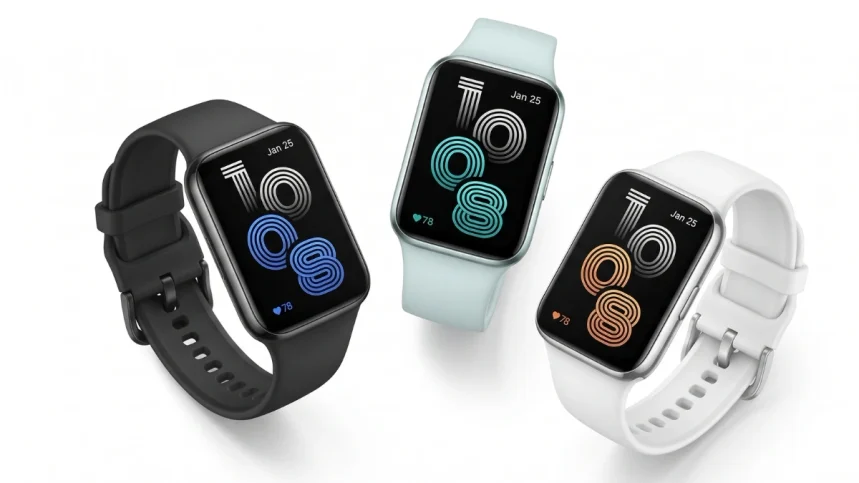
The upcoming Samsung Galaxy Fit 4 (model number SM-R391) has surfaced in FCC filings and recent supply-chain information. These initial Samsung Galaxy Fit 4 leaks provide insight into what Samsung plans to bring to market, likely alongside the Galaxy S27 series, towards the end of 2026 or the beginning of 2027.
Colors, Design and Display Changes
On the front, you will find a familiar rectangular OLED display. However, it is significantly larger than the 1.6-inch screen featured on the previous ‘Fit 3’. While Samsung has retained the rectangular OLED form factor, it has made the display notably larger than the 1.6-inch screen found on the earlier ‘Fit 3’. The advantage of a larger display is that you can quickly check your heart rate and workout-related data, even while moving during physical exercise.

Samsung has brought a premium feel to the design; the glass display is surrounded by a silver-colored bezel. In the newly leaked renders, the tracker appears in black, white, and light green. It features a new silver bezel, which gives it an even more premium look.

There is still a physical button on the right side for navigating through the menus. The silicone strap now features a ‘quick-release’ mechanism, making it very easy to replace the strap if it gets dirty during a workout. You can use this physical button on the right to access various menu options. Thanks to the ‘quick-release’ mechanism on the silicone strap, you can swap it out in just a few seconds.
Samsung Galaxy Fit 4 Specs and Sensors
A close examination of the Samsung Galaxy Fit 4’s specifications reveals that, while the internal changes are subtle, they are highly effective. It incorporates Bluetooth 5.4 (with EDR), which is significantly more efficient than the Bluetooth 5.3 chip found in the Fit 3. The inclusion of Bluetooth 5.4 (with EDR) is confirmed in the official specifications for the Samsung Galaxy Fit 4. Compared to the Bluetooth 5.3 used in the Fit 3, this minor upgrade offers a more stable connection and improved battery efficiency.
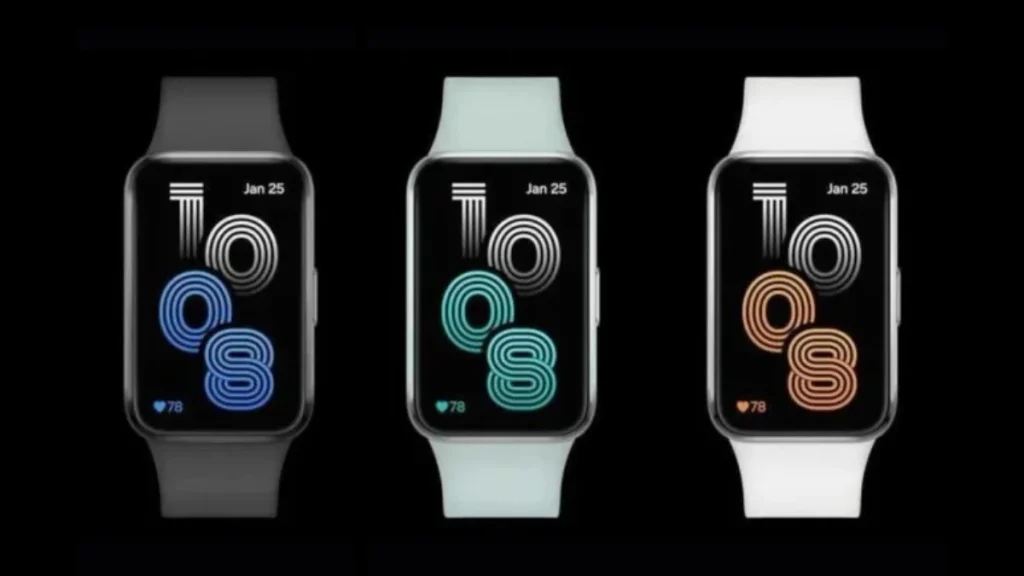
For health tracking, the device features a Goodix GH3036 optical sensor. This sensor is capable of seamlessly handling essential tasks such as continuous heart-rate monitoring and recording data from daily physical activities.
The device is equipped with a reliable battery from EVE Energy. It utilizes standard magnetic charging contacts located on the back of the unit. To maximize battery life, the Samsung Galaxy Fit 4 runs on a simple Real-Time Operating System (RTOS) rather than a more resource-intensive operating system like Wear OS.
Competitors and Expected Pricing
Despite the absence of certain sensors, this tracker is priced significantly lower than its new competitors. It is much cheaper than the screenless ‘Google Fitbit Air’ ($99) and the premium ‘Fitbit Edge’ ($179.99). We estimate that this wearable device will be quite affordable, likely falling between $45 and $60, which is substantially less than the $99 ‘Google Fitbit Air’ and the $179.99 ‘Fitbit Edge.’
This new tracker is expected to officially hit the market sometime between late 2026 and early 2027; it could even be unveiled alongside the Galaxy S27 series.