

The era of the single flagship mobile processor is over because manufacturing cutting-edge silicon has become too expensive. A major Snapdragon 8 Elite Gen 6 leak shows that Qualcomm is dividing its upcoming 2nm hardware into a multi-tier lineup to manage rising production costs. At the top of this new strategy is the Snapdragon 8 Elite Gen 6 Pro, a chip designed to provide extreme power for high-end devices, while its standard counterpart focuses on the high-volume market.
Qualcomm’s Two-Tier Gamble: Power Versus Price
The premium smartphone market is undergoing a significant change as chipmakers transition to the eagerly awaited 2nm fabrication process. The Snapdragon 8 Elite Gen 6 Pro, identified by the model number SM8975, showcases Qualcomm’s top engineering efforts. This chipset features an updated custom Oryon CPU architecture that reaches historic clock speeds of 5.0 GHz. It pairs this impressive speed with an 8MB Last-Level Cache and a large 16MB shared L2 cache.
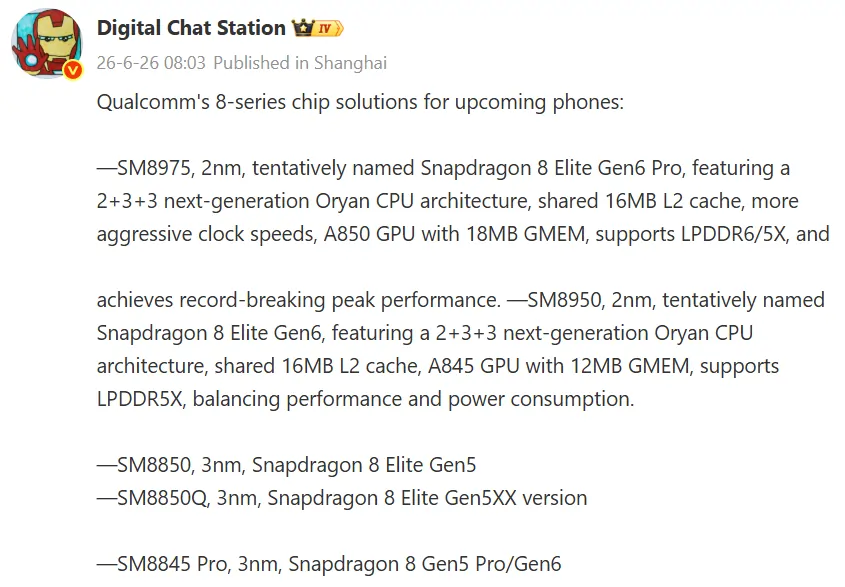
Graphics processing on this elite chip sees a large enhancement from the new Adreno 850 GPU. This graphics component comes with an expanded 18MB of fast on-chip graphics memory. Importantly, the SM8975 is designed to connect to future memory standards. It supports next-generation LPDDR6 RAM in addition to current LPDDR5X modules, giving device manufacturers flexible options for future-proofing their hardware.
To cater to the high-volume flagship market, Qualcomm is also preparing a second chip with the model number SM8950. This processor is likely to be launched as the standard Snapdragon 8 Elite Gen 6. It shares the same basic 2nm node and core Oryon CPU architecture as the Pro model, but it makes careful adjustments to lower component costs and improve thermal efficiency. The Last-Level Cache is reduced to 6MB, but it retains the full 16MB shared L2 cache structure.
The standard version also changes its graphics and memory capabilities. It uses the Adreno 845 GPU, which has a reduced 12MB of on-chip graphics memory. To keep device manufacturing costs down, the standard SM8950 limits its memory compatibility to only LPDDR5X RAM. This skips the expensive integration needed for next-generation memory standards.
Why the Snapdragon 8 Elite Gen 6 Pro Price Increase is Inevitable
The physical differences between these chips arise from the harsh economic realities of modern chip manufacturing. Cutting-edge fabrication processes and premium memory standards have become incredibly expensive to produce. Industry estimates suggest that the price of the Snapdragon 8 Elite Gen 6 Pro will see a significant increase. When paired with next-generation LPDDR6 RAM, the elite chip is expected to have a wholesale cost of over $300 per unit for device manufacturers.
In contrast, the standard Snapdragon 8 Elite Gen 6 is estimated to be closer to $200. This $100 price difference allows smartphone brands to roll out true premium devices without pushing retail prices to extreme levels. Phone makers can reserve the premium Pro variant for high-end ultra-flagships, gaming devices, and advanced foldables.
In addition to RAM and pricing, both chipsets will introduce a major storage upgrade. This flagship tier will officially adopt the new UFS 5.0 storage standard. UFS 5.0 effectively doubles the sequential read and write speeds compared to current UFS 4.0 storage technologies. This increase in bandwidth is crucial for reducing app loading times and enabling complex on-device generative AI models to load large parameter files into memory quickly.
MediaTek Magni GPU Challenges Qualcomm 2nm Supremacy
While Qualcomm segments its lineup, MediaTek is pursuing a focused strategy to shake up the premium mobile market. The semiconductor company is preparing a three-part approach across both 3nm and 2nm processes. Its main aim is to dominate graphics and neural processing.
The highlight of MediaTek’s upcoming range is the 2nm Dimensity 9600 Pro. Powered by Arm’s next-generation Cortex C2-Ultra CPU cores, this processor matches Qualcomm by achieving clock speeds of up to 5.0 GHz. It supports full LPDDR6 memory and UFS 5.0 storage.
The real change happens in the graphics department. The Dimensity 9600 Pro introduces the new Magni GPU architecture, which works seamlessly with an integrated NGP neural accelerator. This combination enables advanced, console-level frame interpolation, highly improved ray tracing capabilities, and much better rendering efficiency. Early supply chain evaluations suggest that the Dimensity 9600 Pro may outshine Qualcomm’s standard Snapdragon 8 Elite Gen 6 in sustained GPU tasks, making it an excellent platform for LPDDR6 RAM smartphones and mobile gaming.
Early samples of the Dimensity 9600 Pro on benchmark platforms like Geekbench 6 support this performance claim. The silicon is currently achieving single-core scores between 4,200 and 4,300 points. Its multi-core performance ranges from 12,000 to 12,500 points. These figures indicate that MediaTek is closing the historical performance gap with Qualcomm.
MediaTek does not depend on just one 2nm chip for its premium lineup. The complete Dimensity 9-series features three versions aimed at different launch dates and price points. At the baseline sits the Dimensity 9500+, which is an optimized, overclocked version of MediaTek’s existing 3nm flagship platform. Above that is the standard 2nm Dimensity 9600, offering a lower peak GPU configuration compared to the Pro version but providing the efficiency benefits of the 2nm process to a broader market. The lineup concludes with the previously mentioned Dimensity 9600 Pro, featuring MediaTek’s most advanced hardware assets.

Why Qualcomm Is Keeping One Foot in the 3nm Door
While the 2nm node captures attention, Qualcomm is also refreshing its existing 3nm offerings to secure the sub-flagship and premium mid-range segments. This ensures the company maintains its market share even if 2nm production faces early supply issues.
The current flagship, the SM8850 or Snapdragon 8 Elite Gen 5, will soon be complemented by a specialized variant called the SM8850Q. This processor is expected to be marketed as the Snapdragon 8 Elite Gen 5XX Edition, offering slightly adjusted clock settings for specific device partners.
The roadmap includes another chip named the SM8845 Pro, an upcoming platform that might be released under the Snapdragon 8 Gen 5 Pro or Gen 6 branding. This chip is designed as a minor upgrade over the standard Gen 5 architecture. It serves as an efficient, well-crafted option for device makers wanting premium performance without paying the high price of the new 2nm Oryon generation. This multi-tier approach means buyers will see more variation in phone performance and pricing, with the ultra-premium tier defined by the capabilities of the Snapdragon 8 Elite Gen 6 Pro.








The era of Snapdragon 8 Elite Gen 6 Pro single flagship chip – Thank you!
$300 wholesale just for the processor? Base model flagship phones are easily going to cross the $1,300 mark next year. This is getting out of hand.