


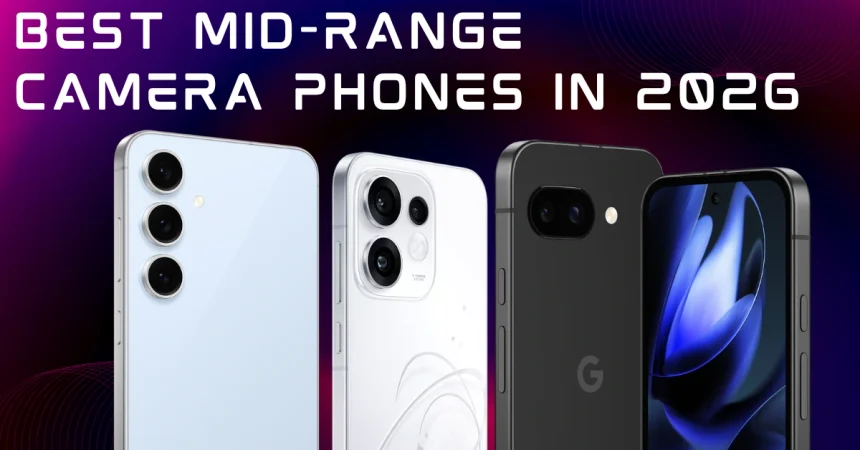
Many smartphone buyers still believe they can capture ‘pro-grade’ or professional-quality photos only with flagship or exorbitantly expensive phones, leading them to spend as much as ₹1,00,000. However, the best mid-range camera phones in 2026 have debunked this myth by combining high-quality sensors with flagship-level computational tuning.
Thanks to smart lens tuning and high-speed processors, phones priced under ₹70,000 are now easily capable of capturing crisp, print-worthy images. Below, we compare how today’s top phones stack up against one another in terms of real-world performance across photography, battery life, and overall operation.
Best Mid-Range Camera Phones in 2026
| Smartphone | Camera Key Features |
|---|---|
| Google Pixel 9a | Rear: 48MP Main (OIS), 13MP Ultrawide Front: 13MP |
| Xiaomi 15T Pro | Rear: 50MP Main, 50MP 5x Periscope, 12MP Ultrawide Front: 32MP |
| OPPO Reno16 5G | Rear: 50MP Main, 50MP Ultrawide, 50MP 3.5x Telephoto Front: 50MP |
| Samsung Galaxy S24 FE | Rear: 50MP Main, 12MP Ultrawide, 8MP 3x Telephoto Front: 10MP |
| Nothing Phone (4a) | Rear: 50MP Main (OIS), 50MP Periscope, 8MP Ultrawide Front: 32MP |
1. Google Pixel 9a:
The Pixel 9a proves that software optimization often matters more than the sheer number of camera sensors. It is our top-rated mid-range camera phone, capable of capturing flawless portraits with accurate colors in any lighting condition.

Its camera system features a 48-megapixel main sensor with stabilization, a 13-megapixel ultrawide camera, and a 13-megapixel selfie camera. Google’s Tensor G4 chip handles complex dynamic range with remarkable efficiency, so subjects backlit by strong light don’t look murky or overexposed.
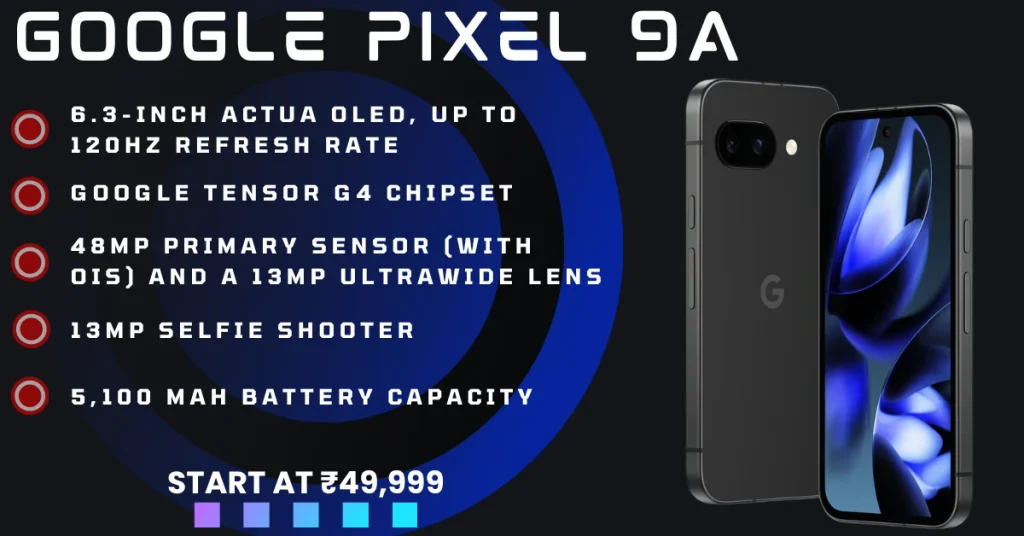
It sports a compact 6.3-inch Actua pOLED display with a dynamic refresh rate ranging from 60Hz to 120Hz, all housed within a durable, IP68-rated body. Its 5,100 mAh battery supports fast and wireless charging and lasts over 30 hours on a single charge.
Google guarantees 7 years of full OS and security updates, making this phone a great choice for long-term use. Priced at ₹49,999 for the 8GB RAM and 256GB storage configuration, it offers an unbeatable deal for photography enthusiasts.
2. Xiaomi 15T Pro:
If you want a studio-quality camera experience, the Xiaomi 15T Pro has established itself as a formidable contender among the best mid-range camera phones of 2026.
Developed in collaboration with Leica, the triple-camera system features a 50MP main sensor, a 50MP 5x periscope telephoto lens, and a 12MP ultra-wide camera. For selfies, it sports a high-quality 32MP front camera that preserves natural skin texture without excessive digital smoothing.
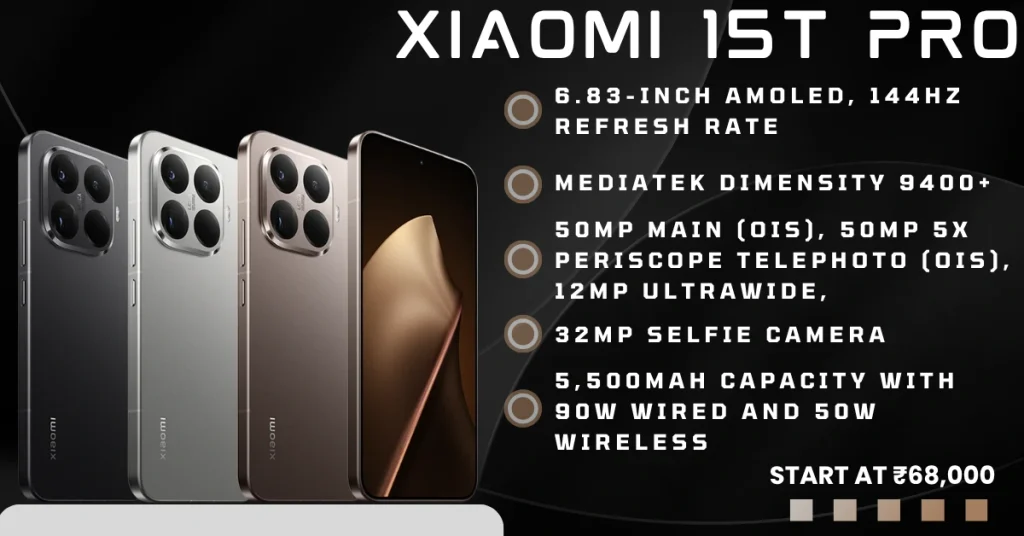
Visuals look stunning on its 6.83-inch 1.5K (2772 x 1280) AMOLED display, which operates smoothly at a 144Hz refresh rate. Protected by Gorilla Glass 7i, the display reaches a peak brightness of 3,200 nits, making it easy to frame shots or view the screen even in direct sunlight.
Under the hood, the phone is powered by the cutting-edge 3nm MediaTek Dimensity 9400+ chipset, paired with 12GB of RAM and storage options ranging from 256GB to 1TB. It runs on Xiaomi’s HyperOS (based on Android 15) and carries an IP68 rating. Additionally, it houses a 5,500mAh battery that supports 90W wired and 50W wireless HyperCharge technology. Depending on the storage variant, the price ranges from ₹68,000 to ₹82,990.
3. OPPO Reno16 5G:
The Reno16 5G not only guarantees long-lasting battery performance but has also carved out a unique niche for itself among the best mid-range camera phones.
It features a versatile rear camera setup comprising three 50-megapixel cameras: a 50MP primary camera, a 50MP ultra-wide lens, and a 50MP 3.5x optical telephoto lens. The 50MP selfie sensor on the front ensures that your portrait shots and video calls are exceptionally clear and sharp.
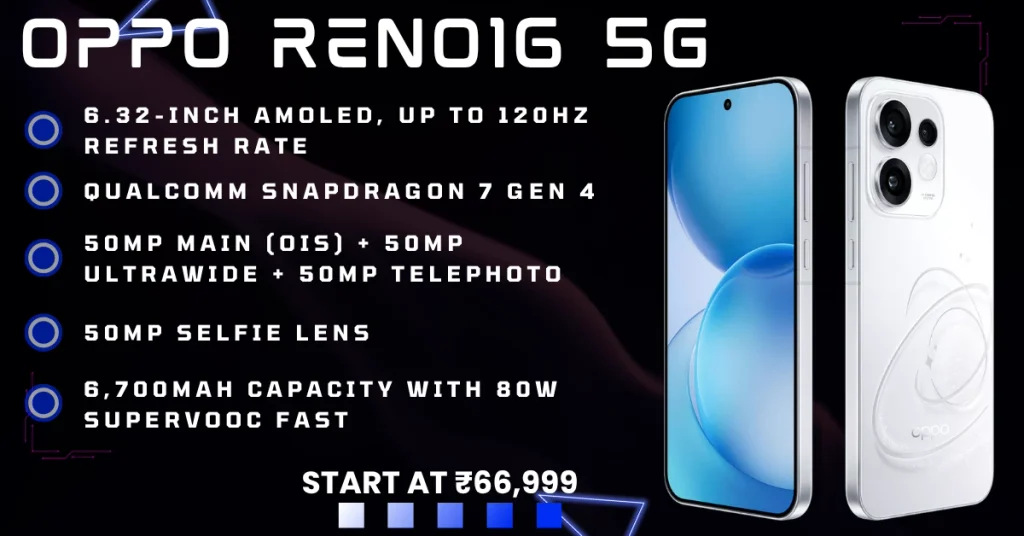
The phone sports a 6.32-inch 120Hz AMOLED display that is comfortable to hold and use. Powered by the Qualcomm Snapdragon 7 Gen 4 chipset, it handles daily multitasking and ColorOS image processing tasks with great reliability.
Its most impressive feature is the massive 6,700mAh battery, supported by fast 80W wired charging. The 8GB RAM and 256GB storage variant is priced at ₹66,999, while the 12GB RAM and 256GB storage variant costs ₹72,999.
4. Samsung Galaxy S24 FE:
For those seeking a high-quality mid-range camera phone in 2026, Samsung’s ‘Fan Edition‘ is a reliable and excellent choice.
Its rear camera setup features a dependable 50-megapixel primary camera, a 12-megapixel ultra-wide lens, and an 8-megapixel telephoto lens with 3x optical zoom capabilities. The 10-megapixel front camera renders natural and balanced skin tones during vlogs or standard calls.
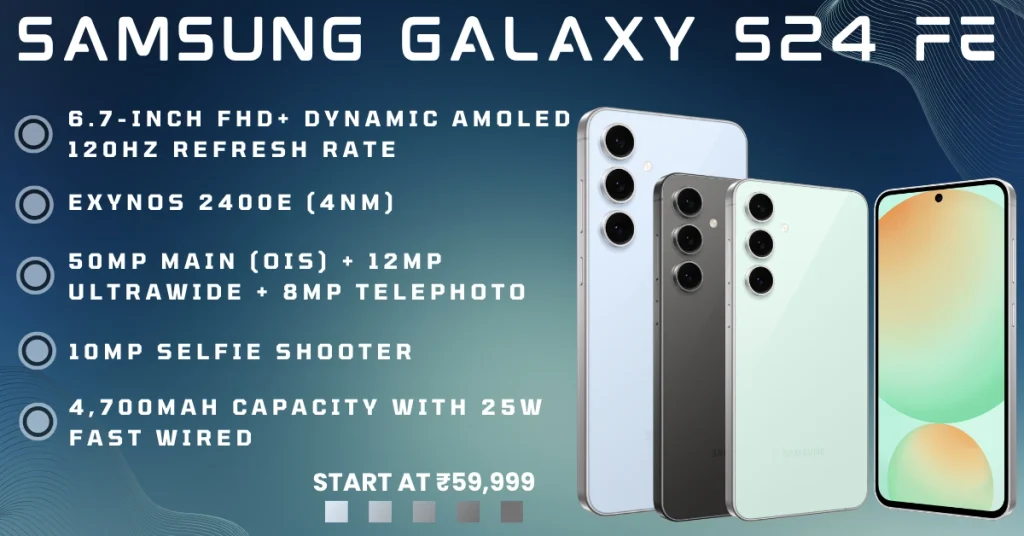
The phone boasts a large 6.7-inch ‘Dynamic AMOLED 2X’ display with a 120Hz refresh rate and a peak brightness of 1,900 nits. It is powered by the 3.1GHz ‘Exynos 2400e’ processor, which effortlessly handles Samsung’s rich color palette.
To keep it running, the phone houses a 4,700mAh battery that supports 25W fast charging. The 8GB RAM and 128GB storage variant is priced at ₹59,999, while the 8GB RAM and 256GB storage model costs ₹65,999.
5. Nothing Phone (4a):
For those seeking a high-quality mid-range camera phone, the ‘Nothing Phone (4a)‘ is an excellent and affordable option.
It features a powerful triple rear camera setup, comprising a 50-megapixel main camera with OIS, a 50-megapixel periscope zoom lens, and an 8-megapixel ultra-wide lens. Additionally, it includes a 32-megapixel front camera for capturing crisp images during daily use.
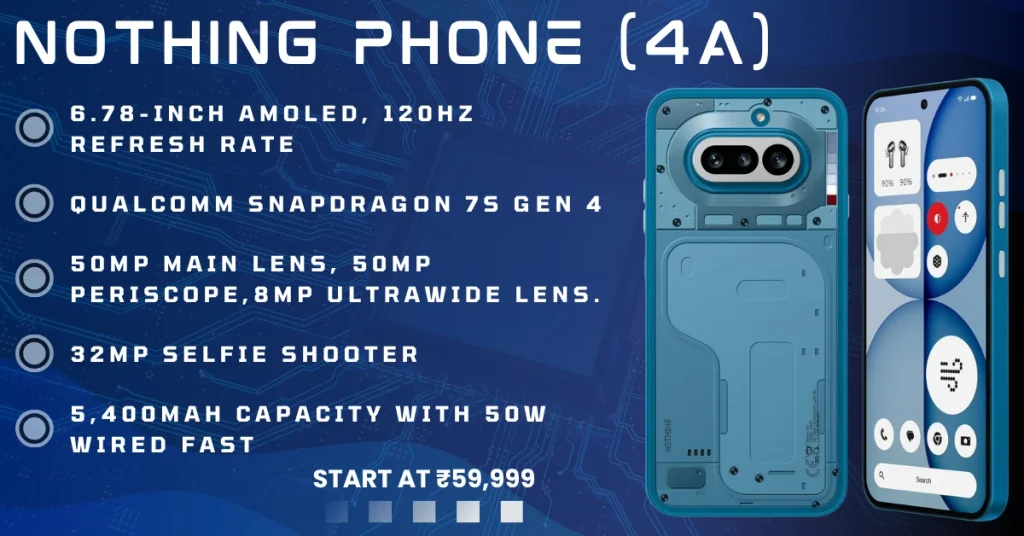
Its 6.78-inch 120Hz adaptive AMOLED display is a standout feature, offering Gorilla Glass 7i protection and a peak brightness of 4,500 nits. The device is powered by the Qualcomm Snapdragon 7s Gen 4 chipset and runs on the clean ‘Nothing OS 4.1’ interface, based on Android 16.
Hardware specifications include an IP64 water-resistance rating and a 5,400mAh battery that supports 50W wired charging. Prices start at ₹31,999 for the 8GB + 128GB variant; the 8GB + 256GB variant is priced at ₹34,999, while the top-tier 12GB + 256GB variant costs ₹37,999.
For most people, the ‘Google Pixel 9a’ is the best overall choice, thanks to its effortless ‘point-and-shoot’ camera magic, long-lasting battery, and unmatched seven years of software support. However, if your priorities are the versatility of optical zoom and powerful hardware capabilities, you might opt for the ‘Xiaomi 15T Pro’ with its Leica telephoto lens; alternatively, for an excellent periscope shooting experience on a budget of under ₹35,000, you could buy the ‘Nothing Phone (4a)’.