

The smartphone industry is encountering limits with raw megapixel counts, prompting manufacturers to rethink how they capture light. Sony Semiconductor Solutions has found a way out with the newly announced Sony Lytia L910. By incorporating LOFIC technology into a high-end mobile sensor, they have addressed the challenging lighting conditions that often overwhelm even the best flagship cameras. This marks a significant change in how smartphone sensors manage intense contrast.
How LOFIC Fixes Blown-Out Highlights
The main breakthrough of the LYT-L910 sensor is its Lateral Overflow Integration Capacitor, or LOFIC. Standard sensors struggle with extremely bright scenes, causing the photodiode to overflow with charge and ruining highlights. LOFIC technology captures this overflow charge directly from the photodiode and stores it, which greatly enhances the saturation capacity. The outcome is an impressive 100dB dynamic range captured in one exposure.
The End Of Multi-Exposure Artifacts
For years, multi-exposure HDR has been the go-to method for balancing bright skies and dark subjects. However, merging several frames often leads to motion blur and flickering artifacts when shooting moving subjects. Sony combines LOFIC with an innovative Triple Conversion Gain HDR (TCG-HDR) system to completely avoid this issue. The TCG-HDR system reads image data from a single exposure using three different conversion gains to significantly minimize highlight blowouts in very bright scenes while maintaining fine details in shadows and mid-tones.

Silencing Hardware Noise With UHCG
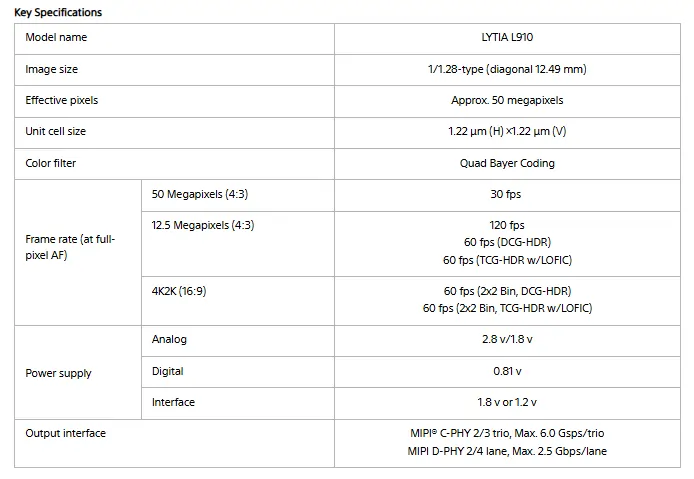
The physical design of this new Sony sensor is already impressive. It features a 1/1.28-inch stacked CMOS design with an effective resolution of 50 megapixels and a 1.22µm pixel size. It uses a Quad Bayer arrangement, grouping four adjacent pixels with the same color filters to balance high sensitivity and high resolution. To ensure a clean signal, an integrated Ultra High Conversion Gain (UHCG) circuit boosts charge-to-voltage conversion efficiency and reduces random noise by about 30% compared to earlier hardware like the LYT-828 sensor.
Beyond Light Capture: The Raw Throughput Of The LYT-L910
Speed is just as important as pure light capture in modern devices. Proprietary circuit improvements in the Sony LYT-L910 significantly reduce the analog-to-digital conversion time. This allows for full-resolution 50-megapixel capture at up to 30fps. It also supports high-speed 12.5-megapixel output at 120fps, along with 4K 60fps HDR video recording in both DCG-HDR and TCG-HDR with LOFIC modes. This processing efficiency enables real-time HDR live previews directly on the smartphone display, even before the shutter is pressed.
Where We Will See It First
Mass production shipments for this component start in the summer of 2026. The Vivo X500 Pro and X500 Pro Max are expected to feature this 50MP 1/1.28-inch sensor as their primary camera. The Xiaomi 18 Pro Max is thought to include a 1/1.28-inch sensor built on a 22nm process to support next-generation LOFIC HDR 3.0. The Sony Lytia L910 provides these upcoming devices with a hardware advantage that software processing simply cannot replicate.