


Samsung’s latest in-house silicon, the Exynos 1680, is beginning to make headlines – and for good reason. While aimed at the mid-range segment, the chip carries some serious ambition, and also some quirks that might leave you thinking twice. Here’s a plain, no-jargon breakdown of what we know so far, and what it means for you if you’re shopping for a good smartphone in 2026.
Exynos 1680: what makes it special
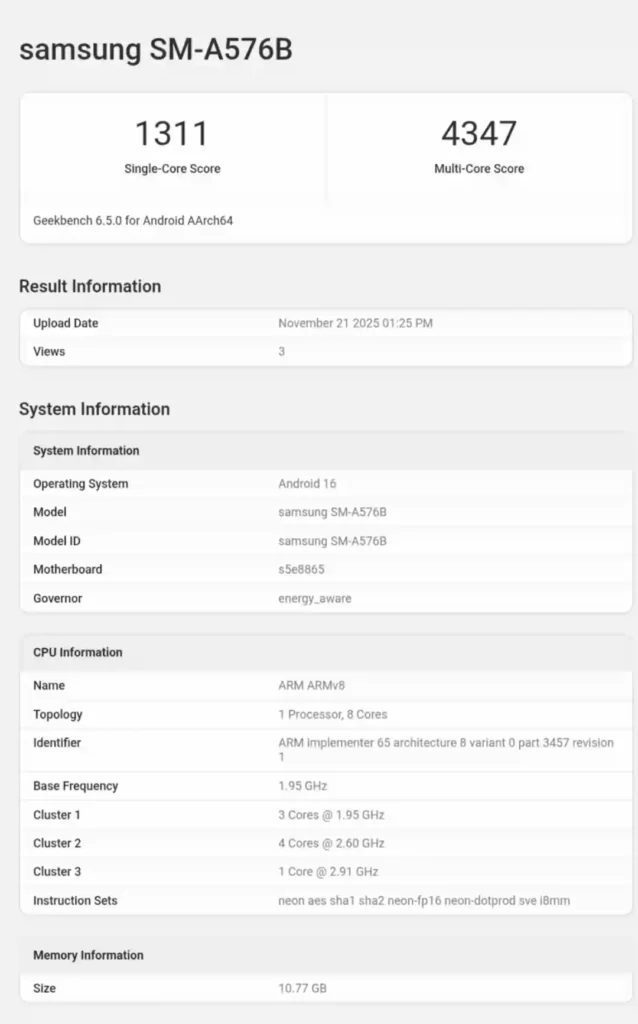
The Exynos 1680 is a new system-on-chip (SoC) from Samsung that appears intended for its “A-series” and other mid-tier phones. According to recent leaks, it uses a 4nm process for better efficiency, and sports a CPU arrangement that looks like:
- 1 “Prime” core up to ~2.91 GHz
- 4 “Performance” cores around 2.6 GHz
- 3 “Efficiency” cores around 1.95 GHz
On the GPU (graphics) front, it’s expected to use the Xclipse 550 graphics module – a step up from the previous Xclipse 540 in the Exynos 1580.

Connectivity is refreshed too: for example, the Exynos 1680 is listed in a Bluetooth SIG entry with Bluetooth 6.1 support.
Why this matters: In simpler terms, you’re looking at a chip that promises smoother performance, better graphics for games or heavy apps, and more modern features – all in a phone that won’t cost flagship money.
While Samsung hasn’t officially launched a phone with the Exynos 1680 yet, we do have strong leads. One of the earliest is the upcoming Samsung Galaxy A57 (model number SM-A576B), which has shown up in benchmarking and certification listings with the Exynos 1680.
Galaxy A57 (rumoured)
- Chipset: Exynos 1680
- RAM: ~12 GB (in test unit)
- Display: ~6.7-inch Super AMOLED, 120 Hz (same size as predecessor)
- Battery: ~5000 mAh (same as current generation), with likely ~45W charging
- Software: Ships with Android 16 + One UI 8.x (rumoured)
So if you’re considering a mid-range Samsung phone launching in early 2026, this is the kind of spec sheet you might be looking at – likely priced significantly below the flagship Galaxy S line but with a lot of modern tech.
The upside – what really stands out
- Better graphics for mid-range phones. With the Xclipse 550 GPU, Samsung is promising a noticeable boost in gaming and visual performance compared with older mid-range chips.
- Modern feature set. The inclusion of Bluetooth 6.1 and other connectivity upgrades shows that Samsung intends this chip to keep up with newer trends.
- Efficiency gains. Using a 4nm process and a smart CPU core layout means better battery life for everyday use (at least in theory).
- Mid-range pricing sweet spot. If Samsung plays it right, you’ll get near-flagship style specs without the flagship price.
- Still early days. The Galaxy A57 (and any other device with Exynos 1680) is yet to be officially released, so real-world performance, heat, battery life, etc, are still speculative.
- Minor upgrade territory. Some leaks suggest the improvement over the previous Exynos 1580 is solid but not dramatic. For instance, single-core scores in early benchmarks are a bit lower, though multi-core scores may climb by ~10 %.
- Competition is fierce. Other chipsets from rival brands (Qualcomm, MediaTek) continue pushing hard, so the “mid-range sweet spot” may get crowded.
- Camera and other features may remain modest. While the chip is strong, the overall phone may still compromise on things like zoom cameras or ultra-premium materials, so you’ll want to check the full specs.
If you’re shopping for a smartphone in the ₹30,000-₹40,000 (or equivalent) range in India or globally, and want a device that’s future-proof and solid for a few years, then yes: waiting for a phone based on the Exynos 1680 seems like a smart move.
However, if you’re upgrading from a fairly recent flagship or you need bleeding-edge performance, ultra-premium features, or top-tier camera zooms, then you might either wait for the next tier or consider a flagship instead.
(Source)