

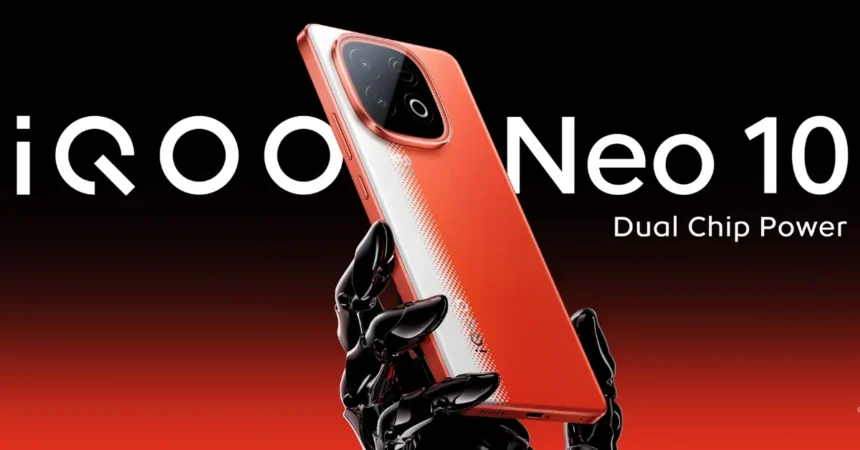
The official launch is set for April 30, 2026, with the first sale available on Amazon and iQOO.com starting May 5. The price begins at an effective ₹34,999 for the 8GB/256GB base model and increases to ₹40,999 for the 12GB version. A 7,000mAh battery in an 8.09mm thin body seems impossible, but the spec sheet reveals a complex story. This preview of the iQOO Neo 10 will explain the impressive engineering and smart hardware choices you need to know.
iQOO Neo 10 Specs at a Glance
The Power-to-Thermal Reality of the iQOO Neo 10
The iQOO Neo 10 features a Snapdragon 8s Gen 4 chipset and achieves an AnTuTu V10 score of over 2.4 million. Typically, such high performance leads to significant thermal throttling in thin devices. The brand addresses this with a 6,043mm² Vapor Chamber, which is almost 20% bigger than the industry average for this price range.


However, the real thermal management comes from the Supercomputing Chip Q1. This extra chip handles tasks such as Motion Deblur and Game Super Resolution, reducing the load on the main Snapdragon processor. This workload division lowers peak power consumption. Buyers should know that this dual-chip setup keeps frame rates stable during heavy use.
The Display and Charging Math of the iQOO Neo 10
A 7,000mAh battery typically makes a smartphone feel heavy. The engineering solution here is the Silicon-Carbon (Si-C) anode technology, which replaces traditional graphite and provides much higher energy density. This innovation allows a tablet-sized battery to fit in the iQOO Neo 10 while maintaining an 8.09mm profile.
But you should pay attention to the charging details. The 120W charging speed looks impressive on paper. However, charging a 7,000mAh battery will take longer than charging a standard 5,000mAh cell. You sacrifice quick charge times for longer overall battery life.
For gamers, the Bypass Charging feature is a significant advantage. This feature sends power straight to the motherboard, avoiding the battery during gameplay. This practice prevents long-term battery wear and helps lower internal heat by 2-3°C.
The Predecessor Legacy & Market Gap
This new generation has learned tough lessons from the older Neo 9 Pro. That model, released in February 2024, came with a 5,160mAh battery and 3,000 nits of peak brightness. The new version surpasses those specs, adding 1,840mAh more battery life and increasing peak brightness to an impressive 5,500 nits.
When you look at the current market, the differences in approach are clear. The Realme GT 7 costs ₹39,999 and focuses solely on the flagship Snapdragon 8 Gen 3 for speed. The iQOO Neo 10 takes a different path, emphasizing sustained gaming with its Q1 chip and larger battery. Meanwhile, the OnePlus 13R is priced at ₹42,999, but it only offers a 5,500mAh battery.
| Feature | iQOO Neo 10 | Realme GT 7 | POCO X7 Pro |
|---|---|---|---|
| Starting Price | ₹37,999 | ₹39,999 | ₹31,990 |
| Processor | Snapdragon 8s Gen 4 | Snapdragon 8 Gen 3 | Dimensity 8400 Ultra |
| Battery | 7,000mAh (Si-C) | 7,000mAh | 5,500mAh |
| Peak Brightness | 5,500 nits | 6,000 nits | 4,000 nits |
The “Fine Print” Warning
The math isn’t perfect everywhere. The most obvious hardware drawback is the USB 2.0 port located at the bottom. While internal storage is very fast, transferring 4K videos or large game files to a PC via cable will be frustratingly slow.

Buyers should also consider the large price difference between the RAM options. There is a ₹6,000 gap between the 8GB and 12GB models. With demanding AI tasks and heavy 1.5K display rendering, 8GB of RAM may soon become a major limitation. The base model seems to serve as a price anchor, merely advertising a lower starting cost.
Pros
Cons
The Final Buying Verdict
If you are a serious mobile gamer who dislikes charging during the day, the 12GB version is a solid pre-order choice. The Si-C battery and Bypass Charging offer real advantages for long gaming sessions. If you often transfer large video files to a computer, the slow USB 2.0 port is a serious drawback. Casual buyers should skip the 8GB base model and wait for real-world memory tests. Choose wisely, as the long-term value of the iQOO Neo 10 heavily relies on investing in that RAM upgrade.