

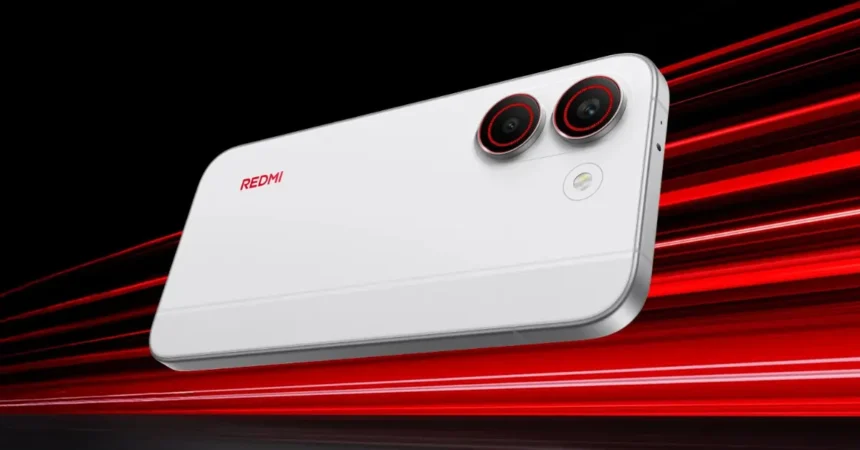
Smartphone design often requires a choice between stylish looks and strong durability. The newly launched Redmi Turbo 5 eliminates that compromise. It aims at a specific group of buyers: outdoor professionals, dedicated mobile gamers, and power users who treat their devices like essential tools. By fitting a large 7,540mAh silicon-carbon battery into a standard smartphone design, Xiaomi has changed the game for mobile hardware. You won’t have to worry about finding a wall outlet before dinner anymore.
Why the 7,540mAh Silicon-Carbon Battery Changes Everything
The battery is the standout feature of the Redmi Turbo 5. Most high-performance phones use 5,000mAh cells, which struggle to last all day during heavy gaming and high-brightness use. Xiaomi created a new silicon-carbon battery that significantly boosts power density. This means you get a much bigger capacity without carrying a heavy phone.
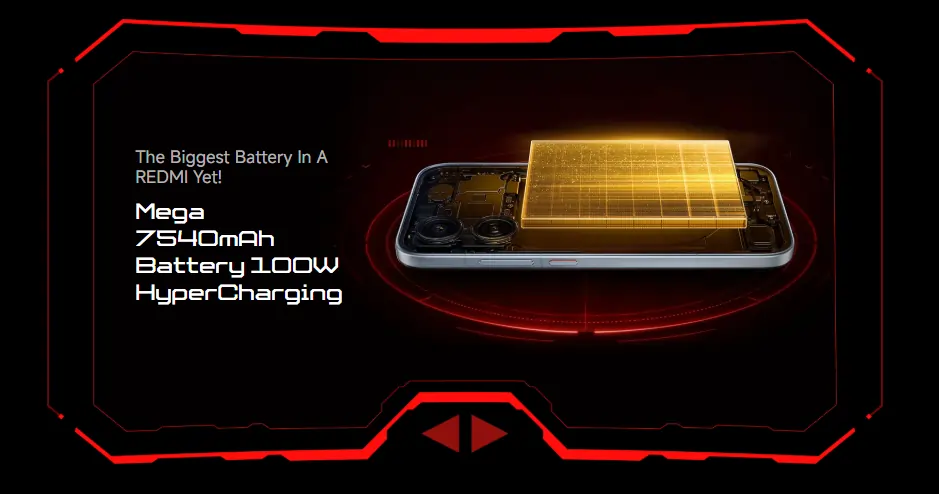
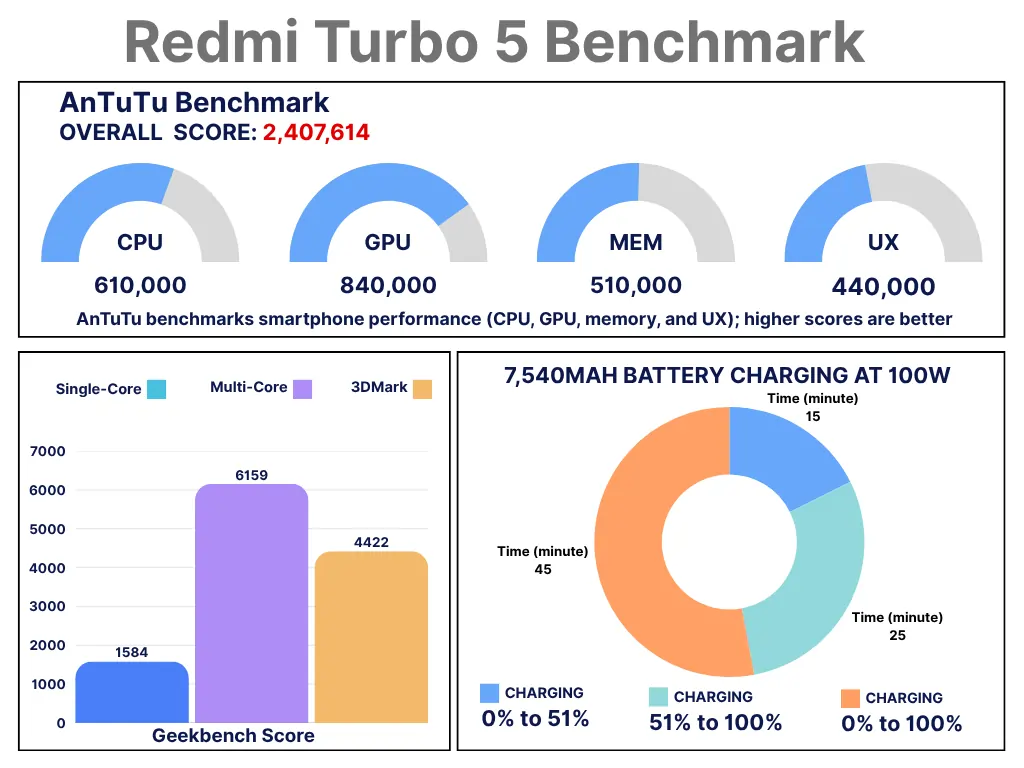
Heavy users can easily game for over 10 hours of non-stop 3D gaming on a single charge. Casual users will likely charge the phone just twice a week. When you need to plug it in, the 100W wired fast charging gets the massive battery from 0% to 51% in just 15 minutes. A complete 100% top-up from dead empty takes approximately 38 to 45 minutes, which is astonishing for a 7,540mAh capacity.

The phone also works as a quick portable power bank. It’s 27W reverse wired charging allows you to connect a Type-C cable and help a friend’s dying phone or recharge your wireless earbuds. The HyperOS 3 smart charging system reduces long-term battery wear by slowing the charging speed when the battery reaches 80% overnight.
The Dimensity 8500 Ultra and the End of Thermal Throttling
A large battery is ineffective if the processor drains it too fast. The Redmi Turbo 5 pairs its powerful battery with the MediaTek Dimensity 8500 Ultra, a very efficient 4nm chip. AnTuTu Benchmark (v11) scores above 2.4 million, showing this device is built for steady, high frame rates. Geekbench 6 scores reach 1,594 points in single-core and 6,686 points in multi-core testing. You won’t experience lag in demanding games, and multitasking is smooth thanks to the ultra-fast LPDDR5X Ultra RAM and UFS 4.1 storage.
Heat is the enemy of mobile performance. Xiaomi addresses this with a large 5,300 mm² vapor chamber and a 3D ice-loop cooling system. This thermal design actively pulls heat away from the processor and battery. The chassis stays comfortably cool in your hands, even while using the 100W charger during a demanding game.
A Display and Build Tough Enough for the Outdoors
The Redmi Turbo 5 can handle a heavy workload and tough conditions. It has IP66, IP68, IP69, and IP69K dust and water resistance ratings. This phone withstands deep water immersion, dust storms, and high-pressure, high-temperature water jets. The glass back and aluminum frame feel premium, but they are designed for harsh environments.
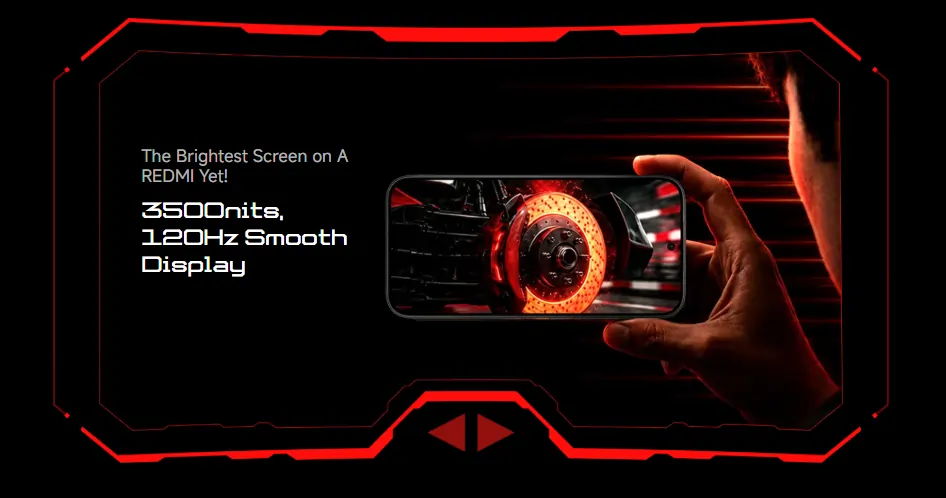
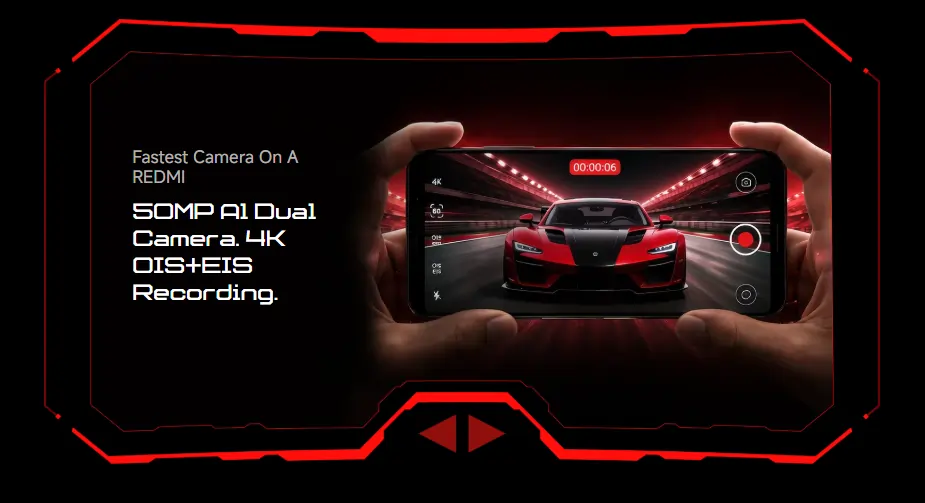
The display matches the sturdy exterior with excellent visibility. The 6.59-inch 1.5K AMOLED flat screen reaches a peak brightness of 3,500 nits. You won’t have any trouble reading maps or enjoying HDR content under bright sunlight. The 120Hz refresh rate keeps animations smooth, while Dolby Vision support ensures vibrant colors. A customizable REDMI Pixel Matrix dynamic RGB ring light completes the rear design.
Photography: Competent, Not Class-Leading
Every smartphone comes with trade-offs. To keep the introductory price at ₹35,999, the Redmi Turbo 5 limits its camera capabilities. The main 50MP Sony IMX882 sensor features optical image stabilization (OIS) and takes sharp, reliable photos in good lighting. However, the secondary 8MP ultra-wide lens is quite standard, and there is no dedicated telephoto zoom lens.
Up front, a 20MP selfie sensor handles video calls. This camera setup is functional and quick, but it isn’t designed for passionate photographers. It captures moments, scans documents, and records smooth video. If you prioritize artistic portraits or extreme zooms, you’ll notice the limitations of this straightforward dual-camera system.
Redmi Turbo 5 vs OnePlus 13R: Which Matters More?
Comparing the Redmi Turbo 5 and OnePlus 13R reveals two different approaches in the performance segment. The OnePlus 13R focuses on traditional flagship quality. It uses the Qualcomm Snapdragon 8 Gen 3 flagship platform with an Adreno 750 GPU and features a larger 6.78-inch 1.5K ProXDR AMOLED flat display with LTPO 4.1 tech and 4,500 nits peak brightness. It also brings a cleaner OxygenOS 15 based on Android 15 software skin and a more versatile camera layout, including an 8MP ultra-wide lens (112° FOV) and a 2MP macro shooter.
| Redmi Turbo 5 | OnePlus 13R 5G |
|---|---|
| MediaTek Dimensity 8500 Ultra (4nm) | Qualcomm Snapdragon 8 Gen 3 (4nm) |
| MediaTek Custom Architecture | Adreno 750 |
| 6.59-inch 1.5K AMOLED Flat | 6.78-inch 1.5K ProXDR AMOLED Flat |
| 120Hz, 3,500 nits peak, Dolby Vision | 120Hz, LTPO 4.1, 4,500 nits peak, Aqua Touch 2.0 |
| LPDDR5X Ultra | LPDDR5X |
| UFS 4.1 | UFS 4.0 |
| Rear: 50MP Sony IMX882 (OIS) + 8MP Ultra-wide | Rear: 50MP Sony (OIS) + 8MP Ultra-wide + 2MP Macro |
| Front: 20MP | Front: 16MP (EIS) |
| 7,540mAh Silicon-Carbon | 6,000mAh Silicon-Carbon |
| 100W Turbo Charging | 80W SUPERVOOC |
| 27W Reverse Wired | Not supported |
| 5,300 mm² Vapour Chamber (3D Ice-Loop) | Standard Flagship Dual VC |
| IP66, IP68, IP69, and IP69K | IP65 |
| HyperOS 3 (Based on Android 16) | OxygenOS 15 (Based on Android 15) |
| 4 years OS / 6 years security | Standard upgrade cycle |
| Customizable REDMI Pixel Matrix RGB ring light | Physical Alert Slider, Gorilla Glass 7i |
The Xiaomi phone has newer software, running HyperOS 3 based on Android 16. It promises 4 years of OS upgrades and 6 years of security patches. If you prefer a polished software interface, a slightly lighter design, and improved photography, the OnePlus 13R is still a great option for everyday use. However, the OnePlus has a smaller 6,000mAh battery, slower 80W SUPERVOOC charging, and standard IP65 dust and water resistance. If you often spend long hours outside, enjoy marathon gaming sessions, and want to avoid a dead battery, the Redmi Turbo 5 is definitely the best choice.