

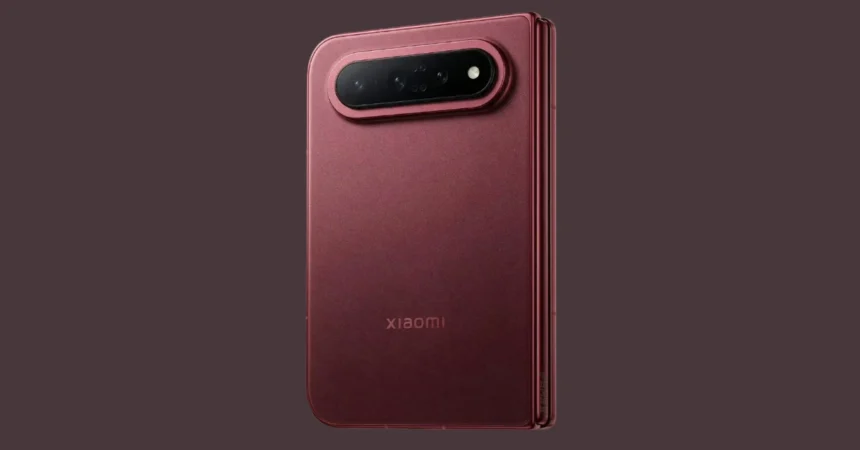
The new Xiaomi 18 Fold has been confirmed with a massive 5.22 million AnTuTu score, and recent pictures of the phone in real life provide our most detailed view of the hardware so far. The Xiaomi 18 Fold leak reveals significant design changes as well as an extraordinary increase in custom processing power.
Xiaomi 18 Fold leak: Design Revealed in Wild
The recently emerged photographs display a phone that is the same as the one seen in the hands of Xiaomi CEO Lei Jun this week. It has the identical eye-catching red finish that Redmi used on the K100 Pro Max. The leaked pictures also provide a much clearer view of the phone’s overall thickness, indicating that it has a notably slim profile when folded.
On the top portion of the back panel, there is a wide horizontal camera module containing three camera lenses together with an LED flash. The extensive arrangement of the components helps to balance the camera bump over the rear case. All the details revealed in this leak of the Xiaomi 18 Fold indicate that the device has a well-polished build designed with daily comfort in mind.

New XRING O3 Processor Brings Major Performance Boost
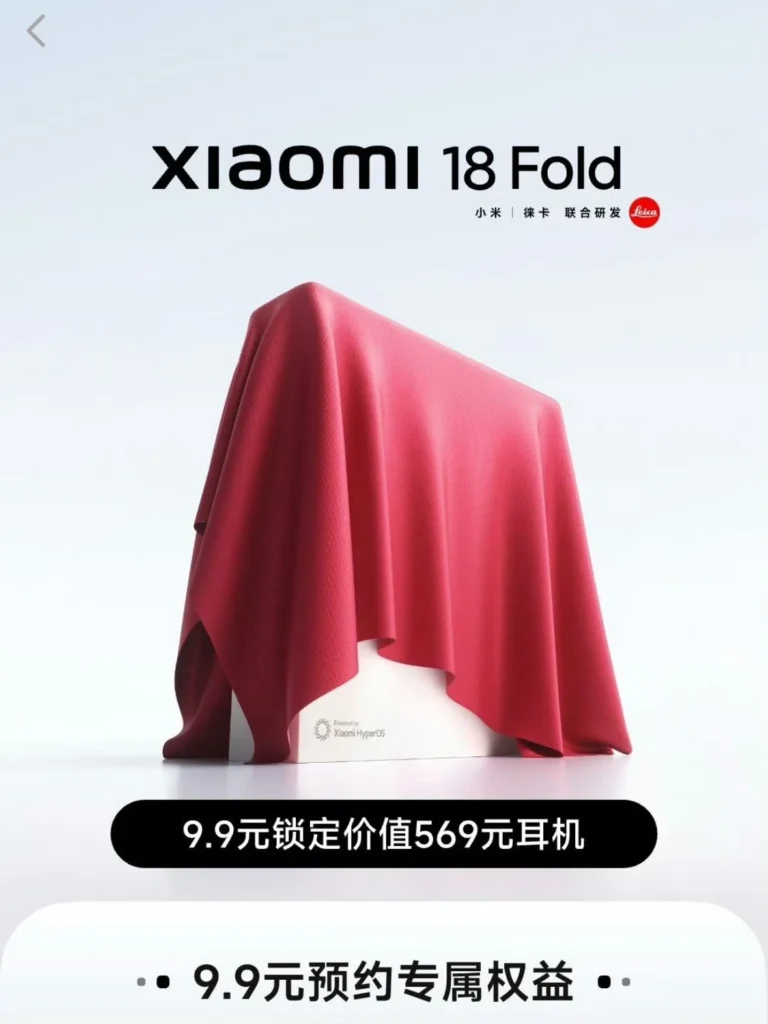
Inside the company, a custom processor is being introduced. Xiaomi has already announced that the Xiaomi 18 Fold will be launched in September, which is when the XRING O3 platform makes its official debut. The chip has recently attracted attention as it is the first mobile processor to surpass the 5-million mark on AnTuTu, scoring 5.22 million points.
The architecture adopts an aggressive approach by incorporating a 10-core CPU made up completely of high-performance cores. By omitting the conventional low-power efficiency cores, the chip scored over 15,000 points in the multi-core tests. This amounts to a pure increase of 60 per cent in computing power compared to last year’s chip, which guarantees that heavy multitasking will not result in slowdowns.
Upgraded G2-Ultra NX GPU and LPDDR6 Bandwidth
The graphics are processed by the brand’s brand-new G2-Ultra NX GPU, which is once again a first for the company. Xiaomi states that this graphics chip provides an 85 per cent increase in visual output together with a 64 per cent reduction in power consumption. This enables prolonged frame rates for gaming and for extended display rendering whilst producing considerably less heat.
Memory speeds receive a major improvement with the move to LPDDR6 support. The system provides a memory bandwidth of 113.8GB/s, which is 48 per cent faster than that of the earlier XRING O1 platform. Since it is a key feature of the Xiaomi 18 Fold, this large data pipeline enables large applications and intensive camera processing to load instantly.
The most recent leak of the Xiaomi 18 Fold shows that the company is not merely carrying out small cosmetic changes this year. The decision to use a custom all-big-core architecture together with modern LPDDR6 memory gives this foldable phone real computational power and also provides it with a clear advantage in the high-end Xiaomi 18 Fold segment, where thermal limitations and performance throttling usually prevent foldable phones from performing well.
Should you at the moment be using an older model of a folding phone, the version being released in September seems well worth putting off. The improvement in graphics efficiency alone addresses one of the main battery-drain problems associated with large-screen foldables. Full pricing and availability details will become known when Xiaomi officially goes on stage next month.