

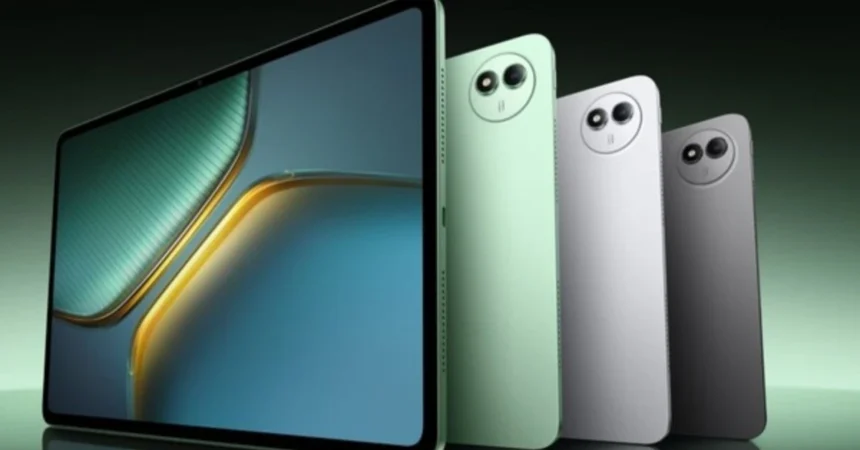
Industry source ‘Digital Chat Station‘ recently revealed key details about a prototype of an unreleased ‘sub-series’ tablet. This mysterious device is currently identified by the model number ‘iPA2691’. Many experts believe this prototype is the upcoming ‘iQOO Pad Mini’. This marks a significant development for the compact iQOO Pad, as it successfully addresses a major issue common to small gaming tablets: excessive heat generation.
Why a Built-In Fan Changes Everything
It has always been difficult for Android manufacturers to produce a gaming tablet with a screen size between 8 and 9 inches that remains cool. The conventional passive cooling techniques, such as the use of graphite sheets and vapor chambers, just do not work when there is heavy gaming. The highly anticipated iQOO Pad changes all that by incorporating a powerful active cooling fan directly inside the compact case. We generally only encounter this kind of mechanical airflow in dedicated gaming phones such as the RedMagic range.
Next-Gen Oryon Cores Pushing 5.0 GHz
The built-in fan is entirely necessary thanks to the new processor that’s been included. The iQOO Pad is currently being tested with the unannounced Snapdragon 8 Elite Gen 6 Pro, which is also referred to as the SM8975. This chip has been manufactured by Qualcomm on TSMC’s advanced 2nm process, representing a major improvement compared to the earlier 3nm architecture. Schematics that have leaked indicate a 2+3+3 configuration of Oryon cores, which drives the peak clock speeds right up to the 5.0 GHz limit.

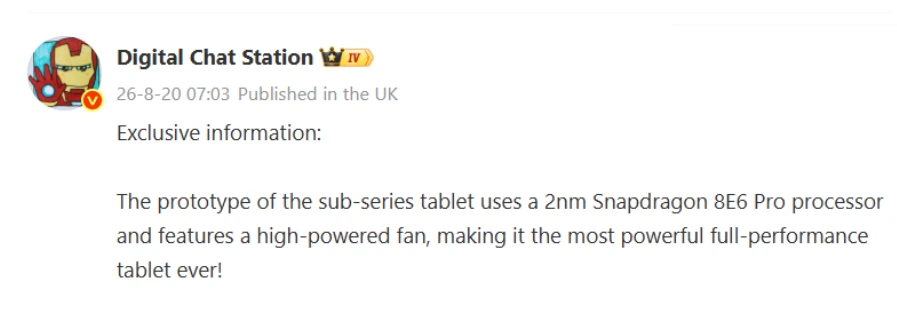
In a small-sized device, forcing the mobile processor to run at 5.0 GHz usually results in heavy throttling within a few minutes, but the mechanical fan prevents this from happening. iQOO combines this powerful cooling system with ultra-fast LPDDR6 memory and UFS 5.0 storage so that applications can be loaded in an instant. The tablet also features an integrated Adreno 850 GPU with 18MB of dedicated graphics memory (GMEM). This particular combination is sufficient for the average user to enjoy complex 3D graphics that remain sharp and without stuttering, rather than just being able to handle simple media consumption.
It takes a great deal of power to run a mechanical fan and a processor operating at 5.0 GHz. In order to achieve a satisfactory screen-on time, the iQOO Pad will need to use a high-density battery cell. Although we haven’t yet seen the exact battery specifications, it will be a challenge to keep the OLED screen bright. For gamers who play away from the charger, a powerful battery is just as important as a fast processor.
When to Expect the iQOO Pad and Projected Costs
Fans can expect the first launch of the iQOO Pad in late September or early October, together with the iQOO 16 smartphone range. A wider launch in India during Q4 2026 is very likely. The iQOO Pad Mini will have to be priced aggressively in order to compete with established products such as the iPad Mini and the Lenovo Legion Y700 series. Should the brand reach the expected price range of ₹38,000 to ₹45,000 in India, it will entirely disrupt the mobile gaming market hierarchy.
This isn’t just a small iterative update; the major advancement from a 3nm chip to a 2nm chip, together with actual mechanical cooling, represents a real hardware innovation. If you’re looking for a compact gaming machine that never slows down, you have no choice but to wait for this release, since it will easily exceed any rival in its class that is cooled passively.