

The true test of artificial intelligence is not the size of a foundation model, but whether 1.4 billion people can actually afford to use it. Avataar AI shows that raw computational size doesn’t matter if the output is culturally inaccurate and costs too much. The launch of the Avataar AI Varya platform in June 2026 marks a complete change in how we assess generative video technology. This is no longer a competition to use the most graphics cards in a huge data center.
How Distillation Destroys the Old Pricing Model
Standard video generation tools from Western tech companies rely on brute force. They usually need over 50 computationally heavy steps to turn a simple text prompt into a polished video. This process uses a lot of computing power and pushes the high cost onto the user. The Varya AI video model completely abandons this wasteful approach.
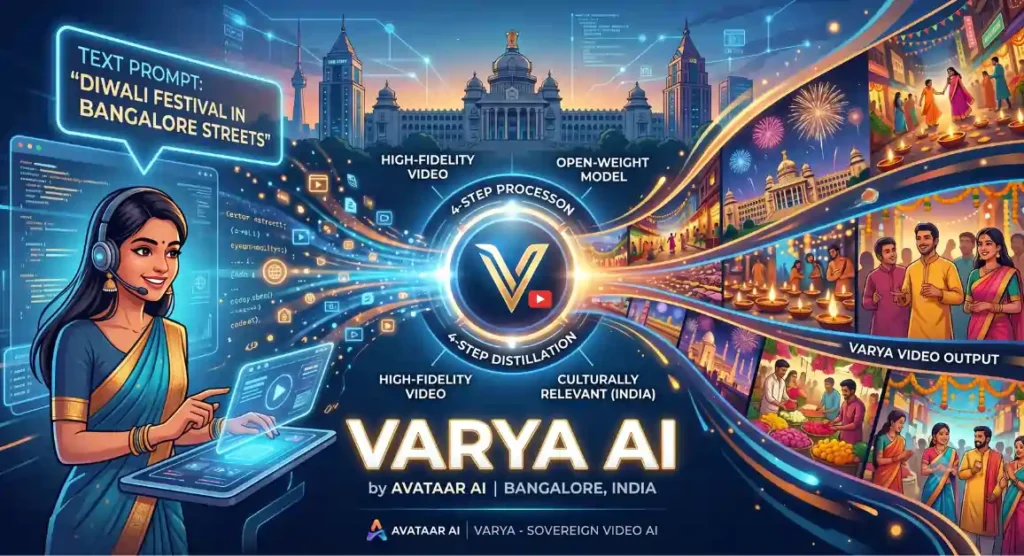
The engineering team uses a machine-learning method called distillation. This technique trains a highly efficient foundation model to avoid unnecessary steps and produce the same high-quality output in just 4 steps. Reducing the computing needs directly changes the old pricing system, generating video at an internal cost of ₹0.48 ($0.005) per second. This makes Varya’s affordable video generation AI about 10x to 27x times more cost-efficient than leading global open-source alternatives.

Escaping the Western Data Trap
A common issue with global AI platforms is their complete reliance on Western training data. While ecosystem giants prioritize consumer updates like the natural language processing in the new iOS 27 Siri voice, localized infrastructure requires a completely different focus. When asked to create content for other regions, these models often produce stereotypical or completely incorrect images. To understand what the Avataar AI Varya model does differently, one only needs to look at its training pipeline. The system accurately represents regional Indian clothing, local festivals, everyday architecture, and specific food types.
This awareness of context turns the tool from a novelty into an everyday utility for local users. A teacher in a rural village can now instantly create visual lessons for a classroom. An MSME can generate localized product advertisements without hiring an expensive production crew. Government agencies can easily create localized informational videos for citizens on a large scale.
Building the Infrastructure for Independence
Bangalore AI startup Avataar did not emerge overnight to chase a sudden tech trend. Sravanth Aluru, an IIT Bombay and Wharton graduate with experience at Microsoft and Deutsche Bank, co-founded the company with Gaurav Baid in 2014. The founders built their reputation as an AI-native transformation partner for global businesses. They spent years developing specialized systems and advanced 3D/video tools for e-commerce, supply chains, and manufacturing.

This strong technical foundation attracted significant investment long before the current hype cycle. The company has raised about $55.5 million across funding rounds, securing major investments from Peak XV Partners (formerly Sequoia Capital India) and Tiger Global Management. Establishing a Sovereign AI infrastructure for India requires just this level of consistent financial support.
Public Infrastructure for Public Access
Building homegrown Indian AI models at this scale requires massive hardware resources. The startup developed Varya with direct backing from the IndiaAI Mission, a $1.2 billion government initiative. Being one of the selected IndiaAI Mission startups gave the team vital access to heavily subsidized national GPU computing resources.
Instead of hiding this breakthrough behind a costly paywall, the company chose a different distribution model. Varya is launching as an open-weight model on AIKosh, the centralized Indian government repository for artificial intelligence datasets. Avataar AI is succeeding by creating an efficient, context-aware system that makes cutting-edge technology accessible to everyone.