
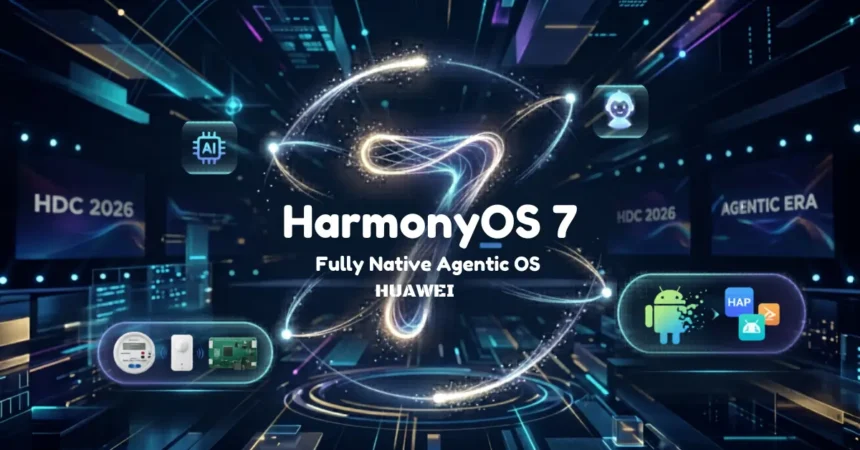
Huawei officially shattered the mobile duopoly by unveiling HarmonyOS 7 on June 12, 2026, at its annual Huawei Developer Conference (HDC 2026). This major update violently drops the last remnants of Android legacy code to transition into a fully native, agent-based AI platform. The Chinese tech giant has replaced basic voice commands with a terrifyingly capable autonomous system.
- How openPangu 2.0 and Xiaoyi AI Assistant Drive the Agent Era
- What are the new features in HarmonyOS 7? Visual Depth Meets Kirin Optimization
- How HarmonyOS 7 Dominates Both Ultra-Light IoT and Automotive Software
- The WWDC Collision: HarmonyOS 7 Challenges Apple’s AI Strategy
- Getting on the Beta List for API 26
The foundation of this shift relies on a complete Android severance. Unlike previous iterations that retained a basic emulated compatibility runtime, the new system fully strips out the Android AOSP layer. Hardware will now execute only native HarmonyOS HAP applications. This aggressive move forces developers to commit entirely to the Huawei ecosystem rather than porting lazy Android clones.
How openPangu 2.0 and Xiaoyi AI Assistant Drive the Agent Era
To understand this software revolution, you must look at the next-gen agentic AI architecture. Huawei built an agent-native system where system capabilities inherently revolve around autonomous workflows. The upgraded Xiaoyi AI Assistant can now execute complex, multi-step actions autonomously, like generating personalized training regimens or fetching files across connected laptops. The system leverages the new Intelligent Agent Framework 2.0 to hit a 90% success rate on multi-step generative AI and text creation tasks without requiring constant user prompts.

The intelligence behind this assistant relies on openPangu 2.0, the large language model deeply optimized for Ascend hardware. The model features a massive 512K context processing capability and ships in two distinct versions. The Pro version utilizes 505 billion total parameters with 18 billion activated, while the Flash version runs on 92 billion total parameters with 6 billion activated. Huawei will open-source the core components, including model weights and inference code, starting June 30, 2026, to attract a massive wave of developer talent.
This approach introduces unprecedented scale to the agent era. Huawei confirmed that the Xiaoyi assistant currently connects with over 2,000 specialized AI agents. This vast network allows the software to understand context and remember past interactions across thousands of specific use cases. The company even integrated AI coding agents directly into the developer beta to assist programmers in writing native HarmonyOS apps faster.
What are the new features in HarmonyOS 7? Visual Depth Meets Kirin Optimization
The interface overhaul introduces new spatial personalization and design philosophies. Immersive 3D graphics now utilize hardware-level processing to create real depth effects, turning typical wallpapers into layered 3D lock screens. Fluid system elements like sliders, buttons, and UI toggles react with an intuitive, physics-based glass-light response that seamlessly follows finger swipes.
These visual upgrades run flawlessly due to aggressive under-the-hood performance updates. Users get a 15% speed improvement thanks to the upgraded core Ark engine, which introduces a refined resource-scheduling mechanism that optimizes app launching and frame consistency. Huawei also implemented Tau’s Law optimization to tightly link hardware and microkernel scheduling in lockstep with their latest Kirin chips.
How HarmonyOS 7 Dominates Both Ultra-Light IoT and Automotive Software
The operating system dominates ultra-light hardware just as easily as flagship phones. Huawei engineers achieved a massive expansion to low-power IoT by re-engineering the base layer to run on a 64 KB footprint, halving the previous 128 KB floor. This industrial and home scale capability extends smart networking to isolated smart utility meters, simple locks, and basic sensors that lack heavy operating system overhead.
The platform also aggressively targets the automotive sector with a massive push into smart mobility. The HarmonyOS NEXT In-Vehicle OS open capabilities feature heavily in intelligent cockpits, specifically driving the screens in vehicles like the AITO M9 series. Major Chinese developers are already part of the Pioneer Developer Program, building native vehicular apps. Heavyweights like Bilibili, AutoNavi, iQiyi, and Tencent Music are actively coding applications that share a unified design language with smartphones and PCs.
The WWDC Collision: HarmonyOS 7 Challenges Apple’s AI Strategy
This launch directly attacks the Western technology establishment. The unveiling of this software took place in the same week as Apple’s WWDC 2026. Huawei’s heavy emphasis on native AI agents serves as a direct, aggressive counter to the newly announced iOS 27 and its overhauled Siri. This global software arms race puts massive pressure on Cupertino to prove its AI features can match a fully native autonomous architecture.
Getting on the Beta List for API 26
The company launched the HarmonyOS 7 Developer Beta, upgraded to API 26, simultaneously with the main stage announcement. Early adopters want to know the exact HarmonyOS 7 eligible devices for the initial testing phase. Eligible flagship hardware includes the Huawei Mate 80 Pro, Mate X7, Mate XTs Master, Pura 90 Pro Max, Huawei Pura X, Huawei Pura X Collector’s Edition, and the Huawei nova 15 Pro.
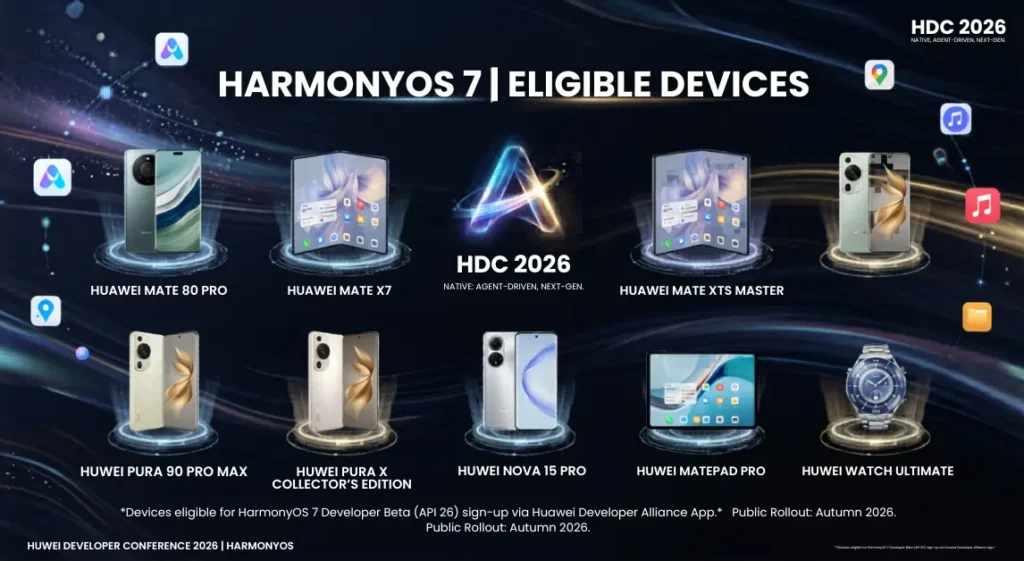
Engineers and enthusiasts can sign up for early access right now through the Huawei Developer Alliance application. Mainstream buyers must wait just a few more months to experience the new software. The stable public rollout of HarmonyOS 7 is scheduled to debut officially in Autumn 2026 alongside the release of the highly anticipated Huawei Mate 90 series.