


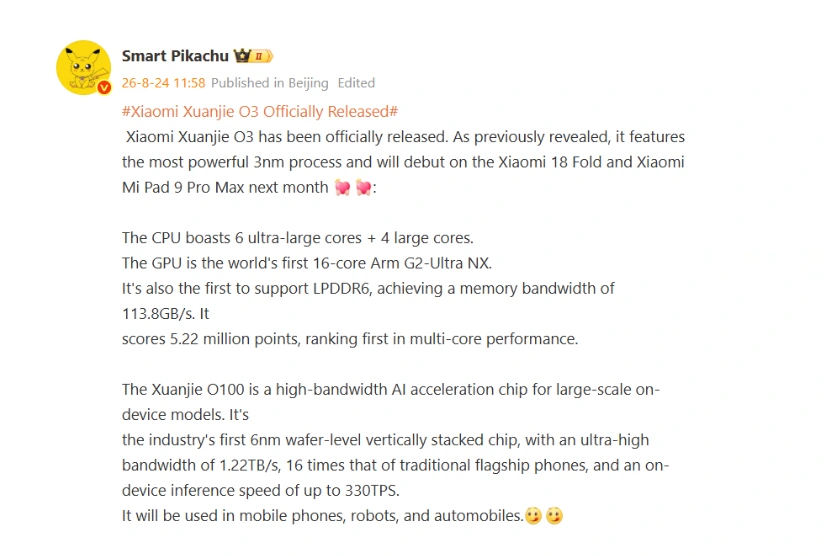
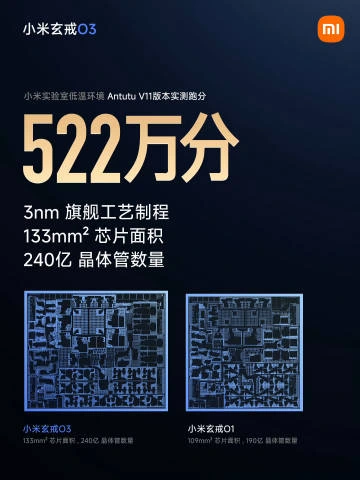
A new mobile processor has recently reached a reported score of 5.22 million in early benchmark tests. Announcements made recently in Beijing via Weibo have shown that this powerful chip is the custom-designed Xiaomi Xuanjie O3. Developed using an advanced 3nm process, the platform is paving the way for the flagship models that are due to be launched next month. This move represents an aggressive shift towards complete in-house control of hardware.
10-Core Performance Meets Next-Gen LPDDR6 Memory
Inside the processor, the Xiaomi Xuanjie O3 moves away from conventional core designs in order to achieve maximum raw performance, incorporating an aggressive 10-core configuration consisting of 6 extremely large cores together with 4 large cores for handling heavy workloads. The visual performance is provided by the world’s first 16-core Arm G2-Ultra NX GPU, which ensures smooth graphics rendering.
Data speeds also see a huge increase. The platform is the first mobile solution to support next-generation LPDDR6 memory, achieving bandwidth speeds of 113.8GB/s. The outstanding feature of the Xiaomi Xuanjie O3 is that it prevents apps from having to be reloaded and ensures that demanding software runs smoothly during everyday use.

How the Xuanjie O100 Powers Next-Gen AI Across Devices
Although the main chip takes care of the computing tasks, the Xuanjie O100 is in charge of large-scale AI models running on the device. It features the industry’s first 6nm wafer-level vertically stacked architecture. This design provides a huge bandwidth of 1.22TB/s, which is as much as 16 times greater than that of conventional top-end smartphones.
Using that bandwidth, the chip achieves on-device inference speeds of up to 330TPS for instant AI processing. The hardware is capable of being used in mobile phones, in robotics, and in the automotive industry. This arrangement means that voice and photo AI features can function right away without having to depend on slow cloud servers.
Next-Gen Hardware Debuts in Upcoming Xiaomi Flagships
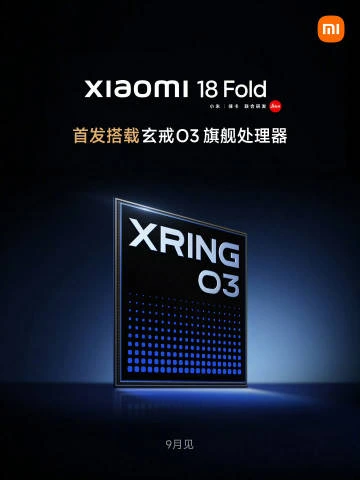
The chipsets will have their official launch next month in the Xiaomi 18 Fold and the Xiaomi Mi Pad 9 Pro Max. By introducing custom silicon into its Xiaomi Xuanjie O3 range, the company is able to challenge existing platforms such as the Snapdragon 8 Elite and the Dimensity 9500. The direct integration of hardware enables hardware and software to communicate with as little battery waste as possible.
Whether or not the Xiaomi 18 Fold and the Xiaomi Mi Pad 9 Pro Max enter the Indian consumer electronics market, it will be their final retail prices in Rupees (₹) that determine their real value. To beat competing devices, they will need to offer a competitive price in Rupees (₹). The decision to move away from off-the-shelf components will result in a significantly faster daily user experience for buyers.
The Xiaomi Xuanjie O3 is not just a simple, step-by-step update; the move to a 3nm 10-core configuration together with extremely fast LPDDR6 memory bandwidth brings about genuine performance improvements when gaming and carrying out heavy multitasking. Should you desire top-level processing power and quick on-device artificial intelligence, then spending your time waiting for the Xuanjie O3 next month is definitely worth it.