

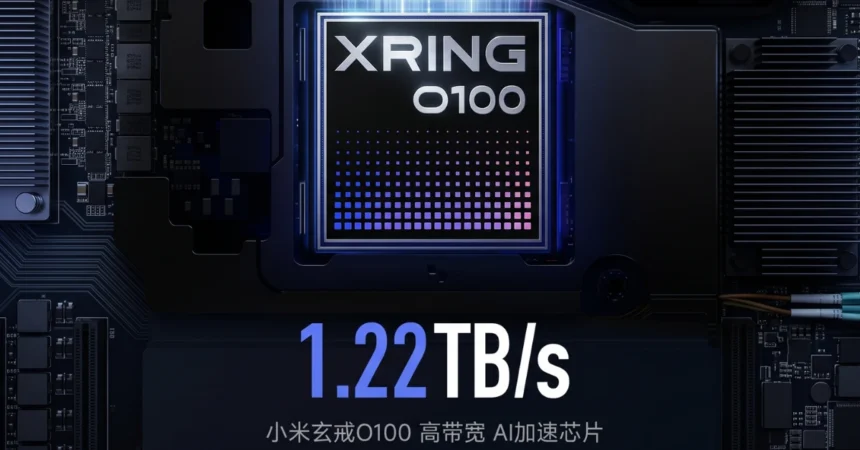
Leaks obtained from Weibo show that Xiaomi is working on a special AI accelerator known as the Xuanjie O100. At the moment, mobile phones face memory limitations because conventional chips place memory flat alongside the processor, causing delays when performing local artificial intelligence functions. The Xuanjie O100 overcomes this bottleneck by means of an industry-first 6nm 3D Wafer-on-Wafer vertical stacking technique.
The sophisticated packaging employs a high-temperature Hybrid Bonding process to bond two layers of AI-optimized high-speed DRAM directly onto a high-performance NPU. The bonding pitch of 1.4 micrometres greatly reduces the physical distance that data needs to travel. This design provides an enormous memory bandwidth of 1.22 TB/s, exceeding current HBM3 standards and approaching the performance of enterprise-grade hardware such as the Nvidia H100.
Why 330 Tokens Per Second Matters
The actual speed that users experience is a direct result of raw bandwidth. Test figures that have been leaked indicate that on-device processing speeds can reach as high as 330 Tokens Per Second, which is 16 times faster than those of current top-end phones. One of the standout features of the Xuanjie O100 is its ability to eliminate cloud latency while at the same time keeping user data private and secure on the device.

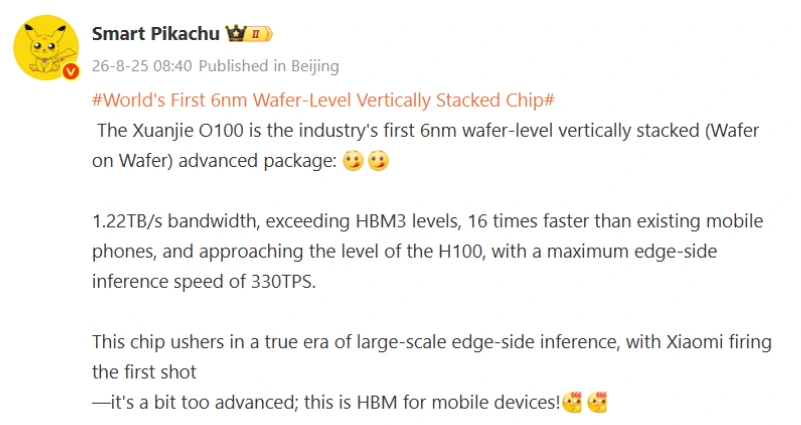
The maximum speed is reached when the Xuanjie O100 is used with Xiaomi’s upcoming 3nm top-end processor, the Xuanjie O3, and runs the local MiMo 3B model developed by Xiaomi. Although third-party models may operate at reduced speeds when in everyday use, common functions such as real-time voice translation and photo generation will take place without any delay.
Why Xiaomi Is Making Its Own AI Hardware
This accelerator is part of a broader strategy aimed at creating custom processors; Xiaomi is at the same time developing the Xuanjie D100, a 3nm chip intended for use in intelligent driving systems. The two chips work together to link the company’s “people, vehicles, and homes” ecosystem into a single hardware setup.
Xiaomi is making active efforts to decrease its dependence on off-the-shelf components supplied by companies such as Qualcomm and MediaTek. The Xuanjie O100 enables the company to have its own hardware stack, thereby altering the way phones manage heavy AI workloads. In the swiftly expanding field of the Xuanjie O100, this custom chip represents a significant advance in hardware and is definitely worth the wait.